Limb stability: why does torsional stiffness matter?
A bow limb doesn't only move backwards and forwards. It can also deform laterally and twist.
The better these unwanted movements are controlled, the more consistently the limb remains aligned throughout the shot - with a direct impact on repeatability and arrow grouping.
Why does this happen? And what role do the materials play?
In this new newsletter, we'll take a closer look at the mechanics behind limb behaviour to help you better understand how your bow works ⚙️😉 .
Lateral limb stability: how it affects your arrow groups
Lateral limb stability is closely related to torsional stiffness - in other words, limb's ability to resist twisting around its axis throughout the shot sequence.
Torsional stiffness plays an important role at two key stages:
- During the draw, it limits limb deformation caused by unwanted forces and helps maintain proper alignment.
- During the release and arrow acceleration, it helps control lateral limb movement, improving shot consistency and arrow grouping, particularly at longer distances.
Lateral limb stability and laminated construction
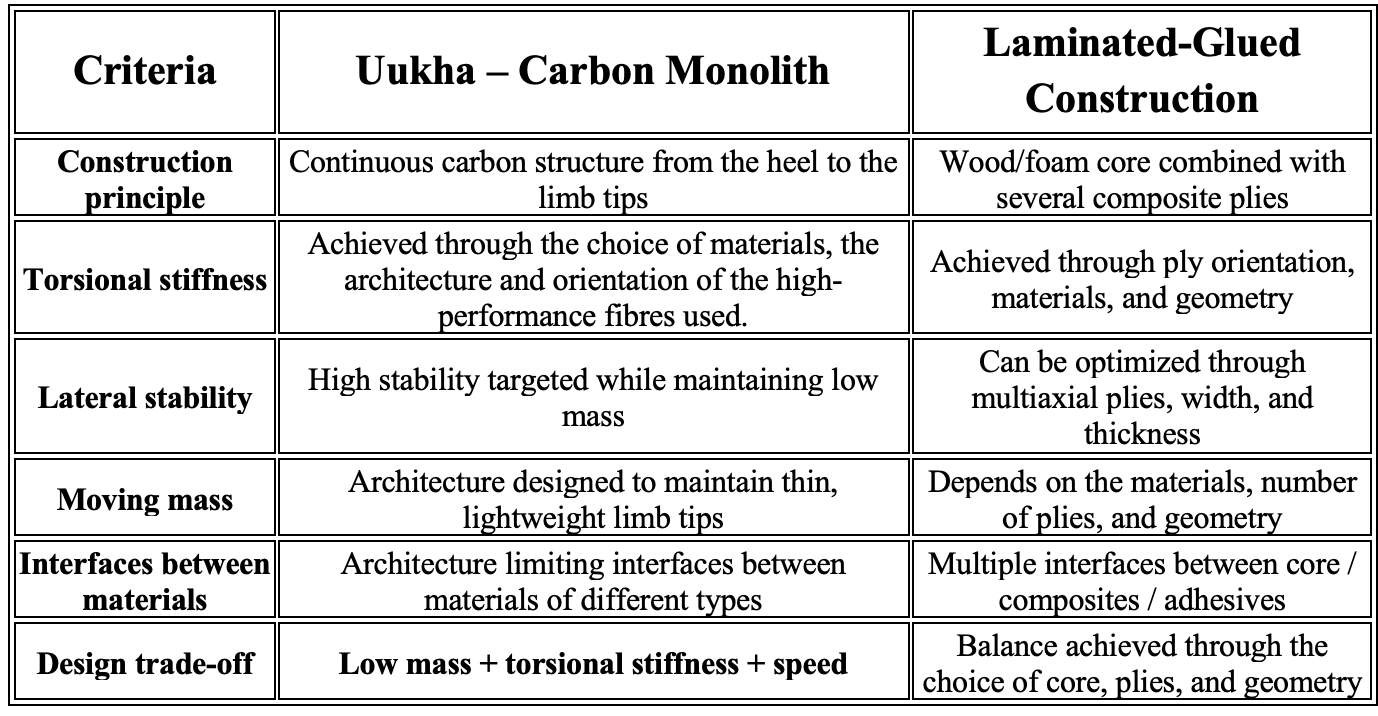
Laminated limbs are built around a foam or wood core, with several layers of composite materials arranged around it.
Their behaviour therefore depends largely on the type, orientation and position of these different layers.
- Fibres positioned longitudinally, parallel to the limb, primarily provide stiffness along its length.
- Other fibre orientations, particularly at ±45°, provide greater resistance to shear forces and torsion, thereby contributing to the limb's lateral stability.
Manufacturers can also adjust this stiffness through the limb's geometry - its thickness and width - as well as through the materials used in its construction.
Trade-Offs and limitations of multi-layer constructions
Carbon/foam and carbon/wood constructions do, however, involve certain compromises.
⚖️ Weight and stiffness
Depending on the design and materials used, increasing stiffness may require adding more material.
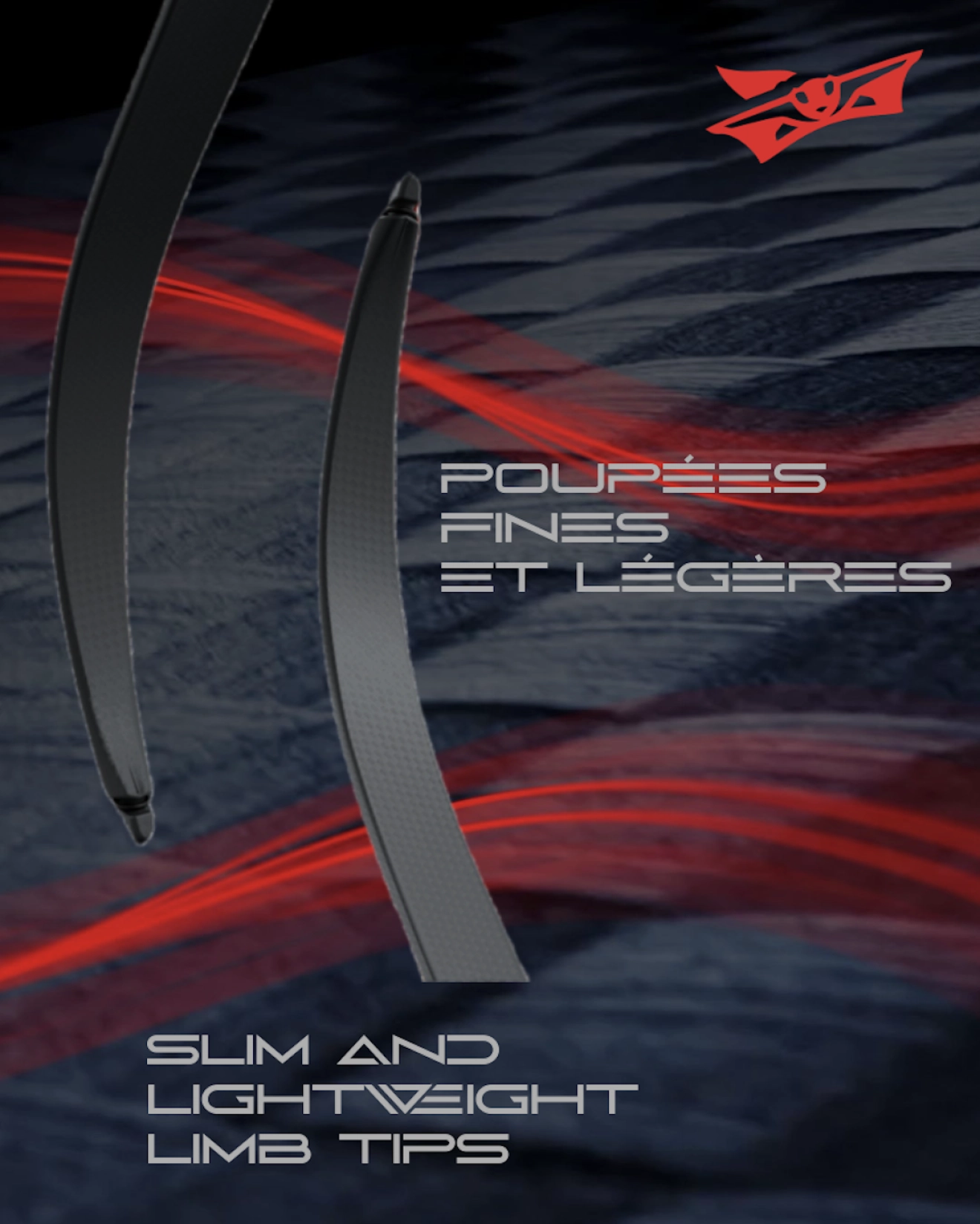
However, weight located towards tips of the limbs is particularly important: the greater the mass in this area, the more it affects limb acceleration, reducing efficiency and ultimately arrow speed.
⚠️ Interfaces that need to be carefully controlled
A laminated construction also creates multiple interfaces between different materials.
The bonding, compatibility and mechanical behaviour of these interfaces must be carefully controlled to ensure that forces are transferred efficiently throughout the entire limb.
Uukha: Monolith Carbon and stability
With Monolith Carbon, Uukha takes a different approach: the structural fibres run continuously throughout the limb, from the butt to the tips.
Combined with our specific layering and fibre-orientation process, this construction is designed to achieve low mass, high torsional stiffness and speed simultaneously.
Result :
Lightweight, fast limbs that also deliver high torsional stiffness and excellent lateral stability.
This combination helps maintain limb alignment, makes the bow more forgiving of small variations in the archer's technique and, ultimately, promotes greater shot-to-shot consistency and tighter groups.